INTERNATIONAL CONFERENCE ON COGNITION, SOCIETY & WELL-BEING

COGNITIVE INFORMATICS
& COGNITIVE COMPUTING

Technical and Social Dimensions

July 23-25, 2019 – Milano, Italy

WAAS conducted a special session on the social dimensions of cognitive infomatics and cognitive computing at a major international conference organized by the Institute of Electrical and Electronics Engineers (IEEE), the world’s largest technical professional organization, at Politecnico di Milano University, Milano, Italy .

WAAS was responsible for the track COGNITION-SOCIETY-WELLBEING (CSW), which examined the Economic, Social, Political, Educational, Cultural, Psychological and Philosophical implications of rapid advances in cognitive computing, artificial intelligence and machine learning from the transdisciplinary perspective of Art & Science.

IEEE was responsible for the CYBER-PHYSICAL-TECHNICAL (CPT) track covering technical papers on cognitive informatics, cognitive computing, computational intelligence and brain informatics.

This conference provided an opportunity for WAAS to focus on issues regarding the social consequences and policy implications of science and technology, a paramount concern to the Academy’s founders.

The ever accelerating pace of technological development in fields related to cognition and artificial intelligence have momentous implications for the future of global society and human wellbeing. It raises fundamental transdisciplinary questions about the relationship between human beings and the technologies they develop, the process and direction of social evolution, and the social responsibilities of science. The quest to discover the right relation between humanity the creator and the technologies it develops is one of the greatest challenges of the 21st century. Clashing visions of the future project images of unparalleled technological marvels beset by unanticipated and uncontrollable consequences for democracy, social stability, employment, human identity, culture, ecological security and human wellbeing.

The Cognition, Society and Wellbeing track ran in parallel to the technical track with common plenary sessions. It explored opportunities and challenges posed by rapid advances in cognitive science to assess alternative pathways to develop its potentials for promoting human well-being, while mitigating unanticipated threats to human security. Speakers were invited to explore topics such as the similarities and differences between human and machine consciousness and learning, the impact of AI on employment and human security, emerging forms of global social organization, the nature of creativity and wisdom, the integration of objective and subjective dimensions of knowledge, the need for radical changes in education, and other issues.

Main Themes included Thinking, Creativity, Mind & Brain, Education, Symbiotic Art & Science, Technological and Social Evolution

COGNITIVE INFORMATICS
& COGNITIVE COMPUTING

Technical and Social Dimensions

July 23-25, 2019 – Milano, Italy

COGNITIVE INFORMATICS
& COGNITIVE COMPUTING

Technical and Social Dimensions

July 23-25, 2019 – Milano, Italy

WAAS CSW TRACK MAIN TOPICS

Symbiotic Science & Art

  • Foundations of symbiotic systems
  • Technology and society
  • Symbiotic autonomous systems (SAS)
  • Mind, thinking, and rationality
  • Value judgement in decision making
  • Social implications of AI
  • Human-machine cooperation
  • Creativity and wisdom
  • Emotional and affective computing
  • Roles of AI in social organization
  • Computational intelligence in art
  • Trans disciplinary cognition
  • Science and art symbiosis
  • Education for sciences vs. arts
  • Concrete and abstract sciences

Humanity and Technology

  • Evolving relationship between man and the machine
  • Governing technology
  • Managing systemic risk
  • Social responsibility of science
  • Governing privacy and trust
  • Opportunities and challenges of networks
  • Evolution of human-machines roles and relationships
  • Man and machine consciousness
  • Values in decision-making

Mind, Thinking and Rationality

  • Human and AI/machine learning
  • Concepts of social cognition
  • Mind and Brain
  • Psychology and Neuroscience of consciousness
  • Social Physics and cognitive computing
  • Experience in judgment formation
  • Information and value judgements
  • Impact of digitization on the brain, mind and behavior
  • Objective and subjective dimensions of decision-making
  • Anticipation and determinism in decision-making

Creativity

  • Cognition and Mental development – stages and process
  • Conceptual systems and deep thinking
  • Scientific creativity
  • Integral knowledge and holistic thinking
  • Idioms in cognitive linguistics
  • Sense perception, rationality and intuition
  • Emotion, sympathy and affective computing
  • Mathematical ambiguity and ambivalence
  • Ambiguity in law and judicial proceedings
  • Creativity and Individuality

Modeling Social Reality

  • Role of technology in social organization
  • Theories and models of social organization
  • Evolution of social organization
  • New business models
  • Cognitive learning and organizational effectiveness
  • Blockchain as an emerging social organization
  • Modeling global society
  • Complexity and contextuality
  • Cognitive transdisciplinarity
  • Social infomatics
  • Modeling reality for decision-making

Education in the 21st Century

  • What should be taught in an age of infoglut and universal access?
  • The process of learning
  • Experiential learning
  • Effective learning
  • Contextual learning
  • Machine-aided learning
  • Peer-to-peer learning
  • Information transmission losses

COGNITIVE INFORMATICS
& COGNITIVE COMPUTING

Technical and Social Dimensions

July 23-25, 2019 – Milano, Italy

IEEE CPT TRACK MAIN TOPICS

Cognitive Informatics

  • Informatics models of the brain
  • Cognitive processes of the brain
  • The cognitive foundation of big data
  • Machine consciousness
  • Neuroscience foundations of information processing
  • Denotational mathematics (DM)
  • Cognitive knowledge bases
  • Autonomous machine learning
  • Neural models of memory
  • Internal information processing
  • Cognitive sensors and networks
  • Cognitive linguistics
  • Abstract intelligence (αI)
  • Cognitive information theory
  • Cognitive information fusion

Cognitive Computing

  • Cognitive computers
  • Cognitive robotics
  • Autonomous Computing
  • Knowledge processors
  • Cognitive semantics of big data
  • Cognitive machine learning
  • Knowledge manipulations
  • Pattern Recognition
  • Cognitive agent technologies
  • Cognitive inferences
  • Computing with words (CWW)
  • Cognitive decision theories
  • Concept & semantic algebras
  • Fuzzy/rough sets/logic
  • Affective Computing

Computational Intelligence

  • Cognitive computers
  • Cognitive systems
  • Cognitive man-machine communication
  • Cognitive Internet
  • World Wide Wisdoms (WWW+)
  • Mathematical engineering for AI
  • Cognitive vehicle systems
  • Semantic computing
  • Distributed intelligence
  • Mathematical models of AI
  • Cognitive signal processing
  • Cognitive image processing
  • Artificial neural nets
  • Genetic computing
  • MATLAB models od AI

Brain Informatics

  • Brain-inspired systems
  • Neuroinformatics
  • Neurological foundations of the brain
  • Computational brain science
  • Software simulations of the brain
  • Brain system interfaces
  • Neurocomputing
  • Brain models
  • DNA and genome cognition
  • Computational neurology
  • Brain image processing
  • Bioinformatics
  • System models of the brain
  • Cognitive process models
  • Neurocircuit theories

COGNITIVE INFORMATICS
& COGNITIVE COMPUTING

Technical and Social Dimensions

July 23-25, 2019 – Milano, Italy

ICCI*CC 2019 – CHAIRS AND COMMITTEES

HONORARY CHAIRS

Bernard Widrow (USA)

Jerome Feldman (UC Berkeley)

GENERAL CO-CHAIRS

Rodolfo A. Fiorini (PolyU Milan, Italy)

Yingxu Wang (U of Calgary, Canada)

Newton Howard (Oxford U., UK)

PROGRAM CO-CHAIRS

Garry Jacobs (WAAS, USA)

Paolo Soda (U. of Rome, Italy)

ORGANIZATION & FINANCIAL CHAIR

Patrizia Mattioni (PolyU Milan, Italy)


CPT PROGRAM COMMITTEE

Altman, Russ (USA)

Anderson, James (USA)

Ayesh, Aladdin (UK)

Barthes, Jean-Paul (France)

Baciu, George (Hong Kong)

Barghout, Lauren (USA)

Berwick, Robert C. (USA)

Bhavsar, Virendra C. (Canada)

Budin, Gerhard (Austria)

Bukovsky, Ivo (Czech)

Cardarilli, Gian Carlo (Italy)

Chakraborty, Basabi (Italy)

Chan, Christine (Canada)

Chan, Keith (Hong Kong)

Fiorini, Rodolfo A. (Italy)

Pineres, Manuel F.C. (Columbia)

Ferens, Ken (Canada)

Frieder, Ophir (USA)

Fujita, Shigeru (Japan)

Gavrilova, Marina (Canada)

Guo, Mingyi (China)

Howard, Newton (UK)

Hu, Mou (Canada)

Hussain, Amir (UK)

Ishizuka, Mitsuru (Japan)

Kavitha, A. (India)

Kinsner, Witold (Canada)

Kwong, Sam (Hong Kong)

Khrennikov, Andrei (Sweden)

Liu, Cheng-Lin (China)

Liu, Hongzhi (China)

Lu, Jianhua (China)

Luo, Guiming (China)

Luo, Xiangfeng (China)

Mizoguchi, Fumio (Japan)

Moulin, Claude (France)

Nishida, Toyoaki (Japan)

Orgun, Mehmet A. (Australia)

Patel, Dilip (UK)

Patel, Shushma (UK)

Pelayo, F. Lopez (Spain)

Peng, Jun (China)

Plataniotis, Kostas (Canada)

Raskin, Victor (USA)

Rubio, Fernando (Spain)

Chandra Sekhar (India)

Shell, Duane (USA)

Skowron, Andrzej (Poland)

Soda, Paolo (Italy)

Sugawara, Kenji (Japan)

Sun, Ron (USA)

Tsumoto, Shusaku (Japan)

Valdes, Julio J. (Canada)

Wang, Guoyin (China)

Widrow, Bernard (USA)

Wood, Sally (USA)

Xue, Xiangyang (China)

Yarman Vural, Fatos (Turkey)

Zanzotto, Fabio (Italy)

Zhang, Bo (China)

Zhang, Du (Macau)

Zhang, Kaizong (Canada)

Zhang, Wenran (USA)

Zhong, Yixin (China)

Zhu, Haibin (Canada)

Zhu, Hong (UK)

Zhu, Qing-Sheng (China)

COGNITIVE INFORMATICS
& COGNITIVE COMPUTING

Technical and Social Dimensions

July 23-25, 2019 – Milano, Italy

°Õ³ó±ðÌýis one of the most outstanding universities in Europe. In the latest QS World University Rankings the university earns 13 positions with respect to last yearÌý (and 60 positions in the last 5 years) becoming the 170thÌýÌýbest university in the World. Politecnico gains 11 positions in Europe, passing from 85thÌýto 74thÌýplace and, for the third year, it is confirmed the first University in Italy.

In theÌýQS Ranking by SubjectÌý2017Ìýhas achieved an excellent positioning in the areas that characterize its research activity: among theÌýfirst 50 universities in the worldÌýin Architecture and Built Environment; Art & Design; Civil & Structural Engineering; Computer Science & Information Systems; Electrical & Electronic Engineering; Mechanical, Aerospace and Manufacturing Engineering, and among theÌýfirst 100 universitiesÌýin ÌýBusiness & Management Studies; Chemical Engineering; Materials Sciences; Mathematics.

Thanks to these results, according to theÌýQS World University Ranking – Engineering & Technology 2017, Politecnico is ranked 24thÌýin the World, 7thÌýin Europe and 1stÌýin Italy among technical universities. Founded in 1863, it is the largest school of architecture, design and engineering in Italy, with three main campuses located in Milan, the heart of fashion and design industries and venue of Expo 2015, and five more premises around the Lombardy region. Many important scientists and architects studied and taught here; among them Achille Castiglioni, Gio Ponti, Renzo Piano and Aldo Rossi, both Pritzker Prize in 1990 and 1998 respectively, and Giulio Natta, Nobel Prize in Chemistry in 1963. The Politecnico di Milano is organized into 12 departments, responsible for planning of the research strategies, and 4 schools, responsible for the organization of education. Among these, 2 schools cater for the different fields of engineering and 2 schools for the fields of architecture and industrial design. Thanks to a strong internationalization policy, many programs are taught entirely in English, attracting an ever-increasing number of talented international students, which now form a diverse community from more than 100 different countries. In the academic year 2015/2016, 21% of the total students enrolled on Master of Science Programs were international.

Inter and multidisciplinarity is fostered throughout the academic path, and it is the methodological approach of the Phd School and the ASP (Alta Scuola Politecnica), a school for young talents from all over the world, who develop their skills in a teamwork context to pursue complex innovation projects. Teaching is increasingly related to research, a key commitment that enables to achieve results of high international standards, while creating connections with the business world.

Strategic research is carried out mainly in the fields of energy, transport, planning, management, design, mathematics and natural and applied sciences, ICT, built environment, cultural heritage, with more than 250 laboratories; among these, also a Wind Tunnel and a Crash Test centre.

ICCI*CC 2019 – HOW TO REACH POLITECNICO “LEONARDO DA VINCI� CAMPUS

ICCI*CC 2019 will take place atÌýPolitecnico di Milano – Leonardo CampusÌý(Piazza Leonardo da Vinci 32 – 20133 Milano). The Milano Leonardo campus is the oldest of Politecnico di Milano’s campuses. It was inaugurated in 1927 in the buildings which are located in Piazza Leonardo da Vinci. Over the course of the decades the campus has been expanded to encompass new campuses and given rise to a real and genuine university quarter commonly dubbed “Città Studiâ€� (City of Studies). Go to theÌýÌýto find outÌýmore.

DOWNLOAD:

  • Ìý(PDF)

If you land atÌýLinate Airport

  • Air Bus to Centrale Railway Station: every 25 minutes from 6:30 am to 11:30 pm. The cost of the ticket is €5.00
  • Bus no. 73 to Piazza San Babila: every 10 minutes from 6:00 am to 1.05 am. The cost of a single fare ticket is €1.50
  • Bus no. X73 Express to Piazza San Babila every 20 minutes from 7:10 am to 7:50 pm, from Monday to Friday. The cost of the ticket is €1.50

If you land atÌýMalpensa Airport

  • Malpensa Express Train to Cadorna Railway Station: every 30 minutes from Terminal 1. The cost of the ticket is €12. You can buy your ticket online here:Ìý
  • Malpensa Shuttle to Centrale Railway Station:
    every 20 minutes from 5:00 am to 12:15 am from Terminal 1, exit 4. The cost of the ticket is €10.00

If you land atÌýOrio al Serio Airport

  • Terravision Bus to Centrale Railway Station: every 30 minutes from 4:05 am to 1:00 am. The cost of the ticket is €5.00
  • Orio shuttle to Centrale Railway Station: every 30 minutes from 3:00 am to 0:15 am. The cost of the ticket is €5.00

FromÌýStazione CentraleÌýÌý(Railway Central Station) orÌýStazione CadornaÌýyou can take the underground (green line) to the Piola station and then make a 5-10 minutes walk.
ICCI*CC 2019 – ACCOMODATION

Listed accommodations mark down their prices for Politecnico di Milano guests. SoÌýremind to mention you are a Politecnico guest when reserving to get a discount.
The full list of the hotels is available here:
–ÌýÌý(PDF 350 KB)
You can find the hotels on the following map:Ìý. In order to book the hotel withÌýspecial rates, please contact directly the hotel mentioning your participation in the event organized at Politecnico di Milano.

ICCI*CC 2019 – TOURIST INFORMATION

Tourism in Milano

GUIDED TOURS (Let us know what you like best and we’ll organize a tour for you!)

Hey, once you are in Milano, you might wish to consider visiting Venice, and/or Florence, and/or Rome. Venice and Rome do not need any advertising. As for Florence, this is the city of Leonardo da Vinci, the religious fanatic Savonarola (who governed Florence for five years and had books and art publicly burned during his tenure; was repeatedly summoned by the Borgia pope to be judged for blasphemy and similar sins; was finally hanged and burned, but in Florence itself since the governing body of the city wanted it so, not in Rome), of Machiavelli, of the Medici dynasty of politicians (and, later on, also popes), where Brunelleschi built a big double dome for the unfinished Florence cathedral (without the use of a prohibitively large scaffolding, an innovation unheard of at the time), etc. All that in just in the 15th century.

The cultural treasures that Florence has to offer can make you gasp in admiration at the achievements of the human spirit and the vast heritage of the Renaissance in Europe. Florence is so artistically rich that, if not careful, you might acquire the psychosomatic disorder that affects some people from exposure to so much art. It is called the Florence or Stendhal syndrome. This prominent French essayist and novelist wrote after visiting the town in 1817: “I was in a sort of ecstasy, from the idea of being in Florence, close to the great men whose tombs I had seen. Absorbed in the contemplation of sublime beauty. I reached the point where one encounters celestial sensations. Everything spoke so vividly to my soul�. Michelangelo, Masaccio, Rafaello, Donatello and Botticelli are just a few of the names you will read under the breathtaking masterpieces.

Don’t be shy. Just ask for your preferred sites to visit. Chances are that other participants may ask for the same topics, so personalized tours can be arranged! Nevertheless, below are a few tours you can choose from when in Milano.

  • #1 Sforza Castle
    (Italian: Castello Sforzesco) was built in the 15th century by Francesco Sforza, Duke of Milan, on the remnants of a 14th-century fortification. Later renovated and enlarged, in the 16th and 17th centuries it was one of the largest citadels in Europe. Extensively rebuilt by Luca Beltrami in 1891-1905, it now houses several of the city’s museums and art collections, including , , (with an art collection which includes Andrea Mantegna’s Trivulzio Madonna and masterpieces by Canaletto, Tiepolo, Vincenzo Foppa, Titian and Tintoretto), and
  • #2 The Pietà Rondanini
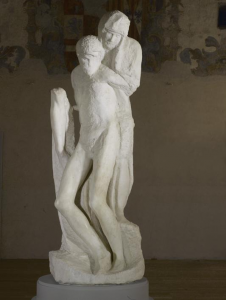
    The is the last incomplete work by (1475-1564). The Pietà is a meditation on death and the salvation of the soul. In this work the sculptor discards the perfection of the human body and its heroic beauty and transforms the dead Christ into an emblem of suffering. The physical arrangement of Mary and Jesus, the mother’s head above that of the son, is suggestive of various moments of the life of Christ: the deposition from the cross; the burial and even the resurrection: in the dissolution of Christ’s body in the mother’s embrace. Left incomplete due to the death of Michelangelo, the Pietà is a testament to the last period of the great master’s creative genius (see more below).
  • #3 Sala delle Asse
    A remarkable record of the presence of (1452-1519) at the Sforza Court, the is the most iconic room in the Sforza Castle. The room owes its name to the wooden wall covering that was used at the time of the Sforzas to render the temperature and ambience of the rooms more comfortable. Formerly painted with heraldic motifs for Galeazzo Sforza, under Ludovico il Moro in 1498 it was transformed by Leonardo’s renowned decoration. Situated on the first floor of the Falconiera tower on the north-east corner of the castle, the Sala delle Asse is Room VIII of the Museum of Antique Art.
  • #4 Highline Galleria
    path suspended along the rooftops of . A 250 meter path that allows you to touch the dome of the Galleria with one hand and the the sky with the other, leaving you fascinated by a 360 degree view over Milan and the surrounding Alps. An exciting path but also a place rich of events and initiatives where you could taste a fantastic aperitif, a funny lunch and memorable dinner.
  • #5 As You Like It
    If you like something else, please have a look below and let us know your prioritized preferences when you register yourself for 2018 ACSGAKC. We’ll try to organize a tour just to match your preferences!

A glance at Milano
Milano comes from the latin name Mediolanon (ancient Greek) or Mediolanum (Latin), meaning a city in the middle of the flat land, or, a city located between the waterways. Located in the Po Valley, between Turin (W) and Venice (E), the Alps, or the main European mountain chain (N), the Apennines and the coast of Ligura (S), Milano is surrounded by enchanting scenarios of flat lands, riversides, the lakesÌýandÌý, hills and picturesque towns and places. Founded by the Celts in 400 B.C., the Romans gave it the name Mediolanum, meaning “in the middle of the landsâ€�. Because of its geographic location, since the beginning it has been one of the most international cities of Italy, a natural crossroad between the Nordic and the Mediterranean cultures. Signs of the History are still visible in the amazing old districts, besides a great heritage of art and architecture. Milestones as theÌý, , , theÌý, can be seen in the city museums, while many modern masterpieces can be observed at the , atÌý and in several other institutions. Historical Libraries as theÌý and the , or the can be visited, while architectural monuments, like DuomoÌý(Cathedral) and , , the can be reached or simply seen walking through the cityÌýcenter. is one of the worldwide symbols of the Opera.ÌýBut Milano is also the Italian capital of , holdingÌýmany events during the year. Parks, hotels, restaurants and places forÌýentertainment richly populate the city. Always moving, the face ofÌýMilano is changing again, and after the big exhibition pavilions of , the new modern district of , designed by , is rising up within many otherÌýbuildings and infrastructures. Among the big, worldwide events recently hosted inÌýMilan, has to be mentioned.Ìý, “36 Hours – The New York Times – What to Do in Milanâ€�,Ìý²ú²â Ingrid K. Williams, provides a lively picture of Milano business, art, and culture.

The few monuments you can’ miss:

  • Roman – The columns of St. Lorenzo Basil
  • Middle Ages, Romanic – St. Ambrogio Basil, The Merchants’ Square
  • Middle Ages, Gothic – The Cathedral
  • Renaissance – The Church of “Santa Maria alle Grazieâ€� (the Last Supper is nearby)
  • Neoclassic – The Opera House “La Scalaâ€�
  • Modern – The Pirelli Tower (in front of the Central Station)
  • Contemporaneous – The Directional Centre around Gae Aulenti square

Important tips:

  • Book your visit to well in advance ().ÌýLast Supper opens April nd it’ likely to be rapidly sold-out.
  • The Opera House “La Scalaâ€� is ending its season on July 19th (). Nonetheless, any day (9AM – 5:30PM) you can and admire the theatre from a box (loge).
  • To discover Milano Google ““
  • For the surrounding area, which embraces many beautiful ancient towns, lakes, and the Alps, Google ““

Michelangelo, Raffaello, and Leonardo in Milano:
The Signature of Complexity in Sublime Imperfection

The perfection of work of arts reflects theÌýperfection of human body and mind expressed by the artist. However,Ìýimperfect works can give us a breakthrough in the complexity hiddenÌýbehind. You will find three marvelous examples in Milano: two byÌýMichelangelo and Raffaello, almost unknown, the third one by Leonardo,
most celebrated.

Michelangelo’s “Pietà Rondanini� – Holism

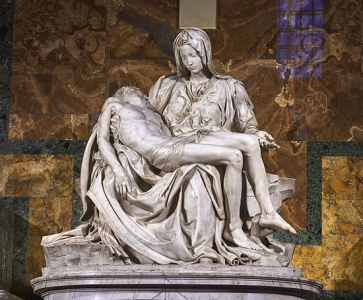
The young Michelangelo had already reached perfection by the renown “Pietà� of the Vatican.


pietarome


The marble he personally selected in the mountains over Carrara (Tuscany) was shaped to live and silent sorrow, to the dereliction of
death, and the gentleness of vests, which makes it a world’s masterpiece.

It’ hard to believe that Michelangelo had more to say in this very subject, but he did by the “Pietà� in Florence and next by the “Pietà Rondanini� in Milano: a life-long, dramatic travel to imperfection, from his first masterwork to the last one.


rondanini


You can see the “Pietà Rondaniniâ€� at the “Sforzaâ€� Castle ()Ìýand the contrast with the former “Pietàâ€� will strike you. MichelangeloÌýworked intermittently on it over more than a decade. He conceived aÌýdaring vertical composition and when it was almost at the end, after twoÌýyears, he completely turned it within the same piece of marble, as onlyÌýhe was able to do (see the Moses). But he never finished. As a result,Ìýwe can simultaneously admire the finished and the unfinished (see theÌýPrisoners). The power of his mind over raw matter comes out revealingÌýthe imagination, the doubts, the suffering of creation hidden in hisÌýfirst Pietà.

Might this be a paradigm of a holistic approach to complexity in Life Sciences?

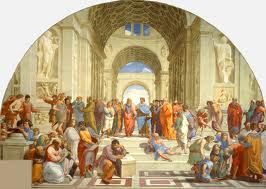
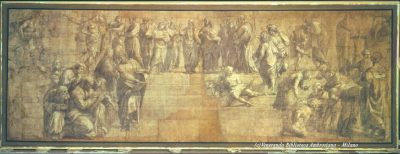
Raffaello’s Preparatory Cartoon of the School of Athens – Reductionism

Who does not know Raffaello’ most famous fresco in the VaticanÌýrooms: the lively and colorful representation of the intellectual lifeÌýof Renaissance through the Greek philosophers?


atene


Conversely, very few do probably know the preparatory cartoon to be admired at the (site also of Leonardo’s Atlantic Code).


cartone


However, even if color is missing, Raffaello’s genius jumps to yourÌýeyes and you see his creative process, which in the finished artwork is astonishing.

Might this be a paradigm of a reductionistic approach?

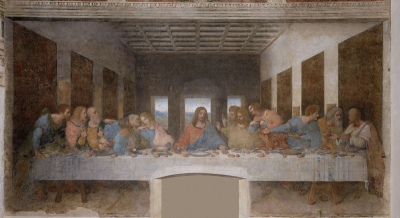
Leonardo’s Last Supper – Always Problems with Methods and Technology

Leonardo kept the same sublime and unique painting style along his entire life.ÌýBut he was also curious about natural sciences and technology, whichÌýmade himÌý Ìýkaleidoscopic talent.ÌýThe mix, however, gave him several troubles in the art of fresco painting, since he wanted to deal with new color techniques and artistic creativity at the same time. Furthermore, he hated the immediacy of fresco work, where the painter must be more rapid than the drying cement on the wall. His experiments led him to disaster in Florence (see The Battle of Anghiari, lost fresco) and almost to, concerning the Last Supper. In fact, the masterpiece immediately started fading and nowadays, after a challenging restoration, it is kept much like in a hospital ICU. Only few visitors are admitted at a time in a strictly conditioned ambient. For this reason, you should book your visit several months ahead.Ìý


cenacolo


Territorial Conclusion

In case the reader came to the conclusion that in Milano we do haveÌýmainly defective items, while all the polished ones are elsewhere (Rome,ÌýFlorence, Venice, Paris, etc.) he or she might be absolutely right.ÌýNonetheless, we are very proud of them, wishing to show the sublimity ofÌýimperfection, as a true paradigm of human complexity.

Some hints for wonderful sightseeing


COGNITIVE INFORMATICS
& COGNITIVE COMPUTING

Technical and Social Dimensions

July 23-25, 2019 – Milano, Italy

ICCI*CC 2019 – CONTACTS